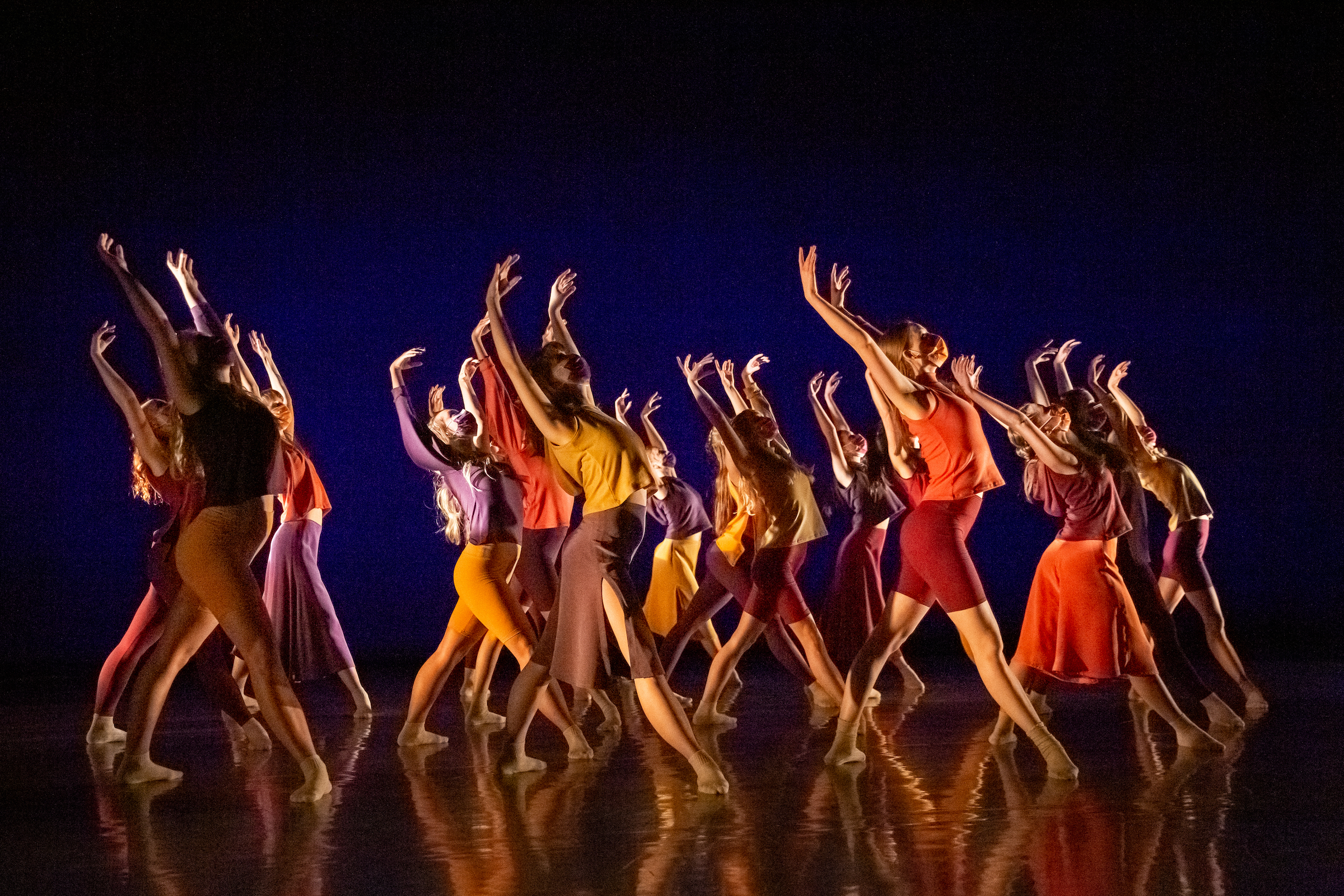


Ella Moore in “Paloma Querida,” choreographed by Michelle Manzanales. Costumes designed by Branimira Ivanova and realized by the School of Dance Costume Shop, with hand-painting by Clover Kelly. Lighting designed by Jared Moore and reimagined by William Peterson. Photo: Todd Collins
WRITTEN BY JULIA LYON

Kiri Avelar had just been hired at the School of Dance when she stumbled across an old pamphlet in the archives. Titled “La Semana de la Raza,” it listed events celebrating Chicano Awareness Week in 1975 at the University of Utah.
“What is this about?” the new Assistant Professor remembers thinking. “Utah does not get a lot of attention in terms of the history of the Chicano movement.”
But here was proof that during the era’s height, U students had been not only participating, but organizing, too. As she continued her research, she understood something that wasn’t obvious at first: the majority of the organizers of the 1975 events were students.
“We’re standing on their shoulders hoping to continue to do that work,” Avelar said.
When she realized the School of Dance had never celebrated Hispanic Heritage Month,
Avelar proposed a dance concert and exhibition to celebrate the 50th anniversary of Chicano Awareness Week on campus — and to launch a new tradition in the school’s dance community.


With only a few months to organize, Avelar collaborated with students and faculty to turn her idea into reality.
Four local Chicana, Latina/x and Latin American choreographers, one of whom is also a current School of Dance graduate student, were chosen to set their work on students. Two had recently finished U degrees.
In the audience was Maria Garciaz, a former University of Utah trustee who started as a U student in 1975, the same year Chicano Awareness Week was first celebrated at the institution.
“I was deeply moved by this concert and the accompanying exhibition,” she said. “Experiencing fifty years of the Chicano and Latinx journey expressed so boldly on stage and thoughtfully curated in the exhibit was profoundly inspiring. I saw myself reflected in the timeline and in the performances — in the resilience, the pride, and the evolution of our community.”
The celebration affirmed the enduring power of the arts, she added, to foster belonging, elevate voices, and strengthen the university community.
One of Avelar’s goals was for high school kids to come see the Latinx Heritage Celebration Concert and understand there’s a space for them at the U.
“When you don’t see yourself represented on stage or in textbooks or in exhibitions, you don’t feel like you belong or that is a space you can contribute to,” she noted.
Michelle Manzanales, a graduate student at the U who has choreographed for Ballet Hispánico, Paul Taylor Dance Company, and Ballet de Jalisco, set her homage to Frida Kahlo on undergraduate dancers.
“I like to make choreography about people like Frida,” she said. “I’m Mexican American, so it celebrates my heritage as well and hopefully brings about curiosity from the audience.”
Each of the students performing in “Paloma Querida” represented a different aspect of Kahlo’s life though none of them identified as Latinx.
“I felt like diving into the role was another element of their training,” Manzanales said.
All four choreographers had different cultural backgrounds.
“We’re not a monolith — we’re all unique, creative voices,” she said. “For the audience, what’s important is to show that broad range.”

Emma McKeever and Claire Cheney in “Niteotl,” created by Stephanie García. Mask-making by the dancers, led by Ramón Ramos. Costumes designed by Christopher Larson. Lighting designed by William Peterson. Photo: Todd Collins

A curatorial collective made up of faculty, students and an alumna, coordinated the exhibition “Half a Century in Motion: Honoring Chicanx Dance, Art, and Activism.” The collective invited students and faculty across campus to submit their work for the month-long show in the Marriott Center for Dance lobby.
“It was eye opening for students to see Salt Lake City was one of the sites of resistance and protest and the fight for civil rights at that time,” Avelar observed.
Katherine Boyce, a BFA School of Dance student, was one of the students in the curatorial collective along with Alexia Maikidou Poutrino and Terra Killpack-Knutsen.
“I don’t identify as Latinx, but I have my own personal borderlands I contend with,” Boyce said. “Obviously there’s no escaping the brutality and reality that the things happening to Latinx communities are horrendous right now. I think anyone is emotionally impacted by that.”
Boyce performed in Stephanie García’s piece, “Niteotl”, inspired by the Deer Dance of the indigenous peoples of Sonora. It felt “really important,” “really powerful,” said Boyce.
The exhibition ultimately included research posters, photographic essays and visual art from students and faculty from various departments across campus including Ethnic Studies and the School of Music. PhD candidate Taryn Carvajal Harding shared her research on Spanglish representation in opera and a link to an aria she’d written. Students from a Latinx music class and all of the classes in the School of Dance toured the exhibition in the lobby, which was filled with bright papel picado, detailed research posters, black and white photos, and colorful paintings.
The opening night included a reception of Mesoamerican food, music, and dancing along with a post-performance conversation with the choreographers, moderated by Boyce and Killpack-Knutsen, giving audience members an opportunity to ask questions.
One person said it seemed like an act of bravery these days to be making art at all.

Em Zinn and Ana Sofia Melendez (featured), with Olivia Hartley, Emelie Bishop, Esther Simmons, Keily Tafiti, Meshayla Gardinier, Aria Gree, Anela Ottley, and Giovanna Harris in “Rasquache,” choreographed and directed by Roxanne Gray. Costumes designed by Chrostopher Larson and Enrique Moreno. Lighting designed by William Peterson. Photo: Todd Collins

Pablo Piantino, an Associate Professor at the School of Dance, helped organize both the dance concert and the exhibition.
“Offering all these different perspectives of dance, of art, of movement offered a different lens from which to look at dance and movement for our students and the community,” said Piantino, who is originally from Argentina. “It felt personally meaningful to celebrate people that come from south of the border. I think we can all learn from one another.”
“Mamonas,” choreographed by Ballet West Soloist Vinicius Lima, celebrated the Brazilian rock band Mamonas Assassinas and was the concert’s final piece. Roxanne Gray’s new work, “Rasquache,” opened it.
“As a Tejana artist, I was so moved by the entire experience,” said Gray, who was also on the curatorial collective and contributed research. “I remember during the Q&A following the concert, all of the choreographers sat on stage and discussed how impactful it felt to be able to express ourselves freely in that space, especially during a time when so many people of color, Latinx, and marginalized communities are being silenced.”
Avelar said she hopes to see the Hispanic Heritage Month celebration events continue at the School of Dance in 2026 and beyond.
“I did not realize how important that month was for me until coming here,” said Avelar who worked at Ballet Hispánico for more than a decade, “Where Hispanic Heritage Month is basically every day.”